Black-box validation framework for shipped software
- Role —
- Test Engineer
- Date —
- 2023
- Stack —
- Java, Black-box testing, Licensing, Automation
Overview
Development of a dedicated test framework, written in Java, to validate an entire software product strictly from the customer’s point of view: no internal access, no debug hooks, only the artifacts actually shipped.
A key focus of the project was verifying that the licensing mechanism behaved correctly under all supported scenarios, since any failure there would directly block customers from using the product.
I was responsible for designing and implementing the test framework and its dedicated tooling, and for defining the validation strategy that ensured the software behaved correctly once installed exactly as a customer would receive it.
Context
The software was delivered to customers as a packaged, installable product. Internal testing up to that point relied on developer environments and internal access, which did not guarantee that the delivered package behaved the same way once installed on a customer’s machine.
A dedicated validation effort was needed to test the product as installed, using only what was actually shipped: the installer, the packaged binaries, the documentation, and the license mechanism — with no shortcuts through internal builds or debug access.
Challenge
The main challenges were:
- Validate the software using only what is shipped to customers, with no internal or debug access
- Reproduce a realistic customer installation environment for testing
- Design and build dedicated test tools in Java to drive and observe the installed software
- Verify that the licensing system correctly grants, restricts, and revokes access under different scenarios
- Cover licensing edge cases: expired licenses, invalid licenses, missing licenses, feature-restricted licenses, license transfer/renewal
- Ensure tests reflected the real customer experience, not an internal shortcut
- Automate a full black-box validation campaign so it could be repeated for every release
- Make results reproducible and traceable across different installation configurations
- Detect regressions introduced by packaging or licensing changes before shipping
My Contribution
I was responsible for the complete black-box validation activity, from framework design to execution.
My main responsibilities included:
- Defining the black-box validation strategy, based strictly on shipped deliverables
- Designing and developing a dedicated test framework in Java to install, drive, and verify the software with no internal access
- Building supporting test tools to automate installation, configuration, and interaction with the installed product
- Designing and implementing licensing test scenarios, covering valid, invalid, expired, and restricted license cases
- Automating verification that licensed and unlicensed features behaved exactly as expected
- Implementing result collection and reporting for traceability across test runs
- Investigating and reporting defects related to installation, packaging, and licensing behavior
- Executing full validation campaigns for each release and maintaining the framework as the product evolved
Solution
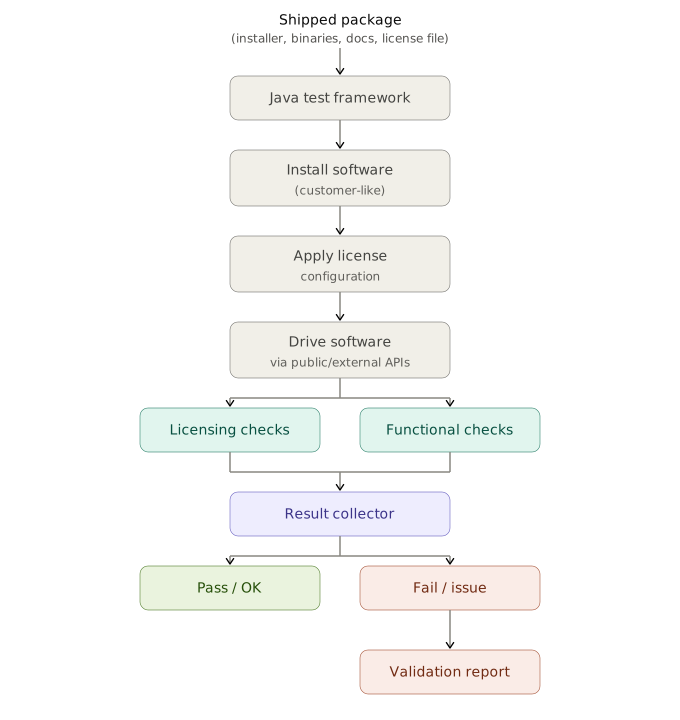
A dedicated Java-based black-box test framework was developed to validate the software exactly as a customer would receive and use it.
The framework installed the product from its shipped package, then drove and observed it through its external interfaces only, with no access to internal APIs, source code, or debug tooling.
A specific test suite targeted the licensing system, systematically checking that the software correctly enabled, limited, or blocked functionality depending on the license state provided.
The framework automated the complete validation workflow:
- Deploy the software from the shipped installation package
- Apply a given license configuration (valid, invalid, expired, restricted, absent)
- Interact with the installed software through its official, customer-facing interfaces
- Verify that licensed behavior matched the expected outcome
- Verify functional behavior of the software under normal use
- Collect results and generate validation reports
- Flag discrepancies between expected and observed behavior
This approach ensured that every release was validated under real customer conditions, catching issues that internal-access testing could miss, particularly around packaging and licensing.
Architecture